

Expert Reports
As well as providing bespoke services to our clients, we also have a number of new non-proprietary reports available for purchase. For further details on costing etc., please contact the author of the report. Click on the report title for further information.
Arabian Plate maps and reports
Barent Shelf Studies
Carbonate reservoir reports

Hydrothermal, burial and fracture-related dolomites:
Insights into reservoirs and analogues
Porous, coarse crystalline dolomites are generally related to fractures and faults and often precipitated from hot fluids under shallow to deep burial conditions. These dolomites may form excellent reservoirs in a variety of tectonic settings world-wide, such as the Albion-Scipio trend (USA); Ladyfern field (Canada); Arab-D reservoir of the Ghawar field (Saudi Arabia) and Tawke field (Iraqi Kurdistan) among others. Despite their considerable importance for hydrocarbon reservoirs, the origin of these dolomite types and their reservoir characteristics are poorly known.
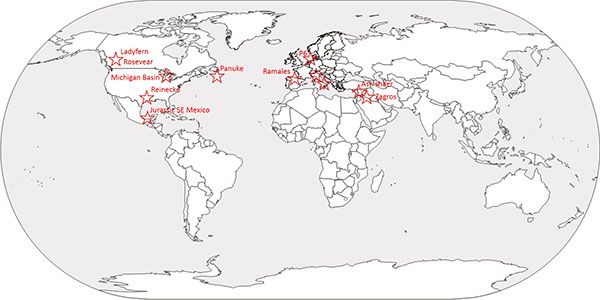
Many dolomite bodies often form the reservoir itself, such as the Vernon or Crystal fields (USA) and recent discoveries have been made in underexplored areas such as onshore SE Mexico. Understanding the occurrence of these dolomite bodies is also important for reservoir management as they often form sweet-spots associated with porosity and permeability enhancement as a result of fracturing and/or dissolution.
In this report, based on a selection of case studies, we discuss the key characteristics of fracture-related dolomite reservoirs and summarise the parameters controlling the development of fracture-related dolomite reservoirs. The emphasis lies on:
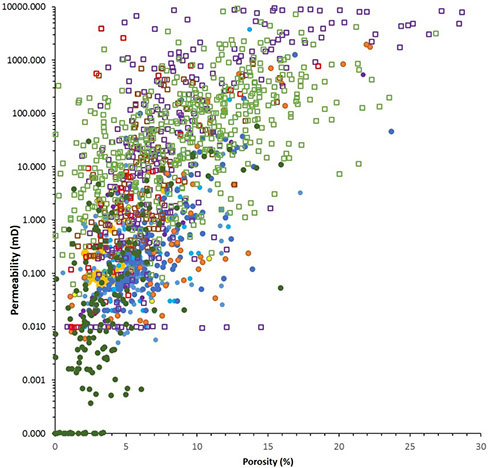
- Their reservoir characteristics, including porosity-permeability ranges, dimensions of the dolomite bodies, reserves and production rates
- Tectonic setting and host rock in which these dolomite bodies form
- The geological “recipe” for the formation of these dolomites.
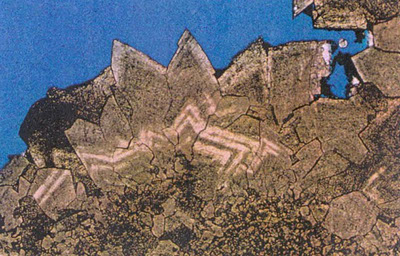
Saddle dolomite (FoV 5 mm)
Porosity-permeability cross-plot of fracture-related dolomites

Fracture-related dolomite with “zebra” texture (grey bands ~1 cm thick)
Overview of case studies discussed in the report
Contact Julie for more information.





4 The Courtyard, 707 Warwick Road, Solihull, West Midlands B91 3DA, UK T: +44 (0)121 705 8472 E: info@cambridgecarbonates.co.uk Legal Notice | Privacy | Contact
© Cambridge Carbonates Ltd